

- This event has passed.
3rd HIGH-PERFORMANCE WORKSHOP
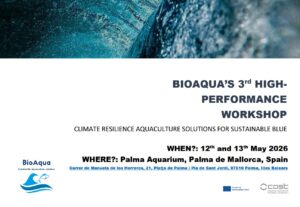
BIOAQUA’S 3rd HIGH-PERFORMANCE WORKSHOP – CLIMATE RESILIENCE AQUACULTURE SOLUTIONS FOR SUSTAINABLE BLUE
“3rd HIGH-PERFORMANCE WORKSHOP”
BIOAQUA COST ACTION
Key Aspects of the Workshop • 
Climate Resilience Aquaculture Solutions for Sustainable Blue Economy
Dates: 12-13 May 2026
Location: Palma Aquarium, Palma de Mallorca, Spain
Theme: Climate Resilience Aquaculture Solutions for Sustainable Blue Economy
Key Aspects of the Workshop
Venue and Organisers: The 3rd High-Performance Workshop of the Action will take place on 12th and 13th May 2026 at Palma Aquarium, located in Palma de Mallorca, Spain. Palma Aquarium is one of Europe’s leading marine centers, combining marine conservation, research, and public education with a particular focus on Mediterranean ecosystems and marine biodiversity protection.
FIRST DAY OF THE WORKSHOP: Monday 12th May 2026
Eva García Muntión, Action Chair, will open the workshop, welcoming all attendees and announcing the agenda for the Workshop. Greetings from Palma Aquarium management highlighted the institution’s commitment to marine conservation and the critical importance of climate resilience in Mediterranean aquaculture systems facing unprecedented environmental pressures.
The first speaker is Dr. Reinhold Hanel as keynote speaker, invited to give a comprehensive overview of “Aquaculture and Water Resilience: Innovation Pathways for a Sustainable Blue Bioeconomy.” Dr. Hanel’s presentation addressed the interconnections between water management, climate adaptation, and aquaculture sustainability, emphasizing the need for integrated approaches that account for changing precipitation patterns, temperature extremes, and water quality challenges.
An active discussion about water resilience strategies and climate adaptation measures followed this inspiring presentation. Then additional presentations selected by the Program Committee were presented, divided according to topic into three sessions during the day.
Session 1: Aquaculture Key Concerns
Chaired by Dr. Orkid Weber, this session is consisted of three presentations addressing emerging challenges in European aquaculture.
Dr. Rajat Nag is presenting “PFAS – A Global Concern for Aquaculture,” examining per- and polyfluoroalkyl substances contamination in aquaculture systems and potential mitigation strategies. The presentation highlights regulatory developments and monitoring approaches for these persistent contaminants.
Caterina Varvara discusses “The Application of Computer Vision Analysis as a Predictive Tool for Harmful Events in Aquaculture,” demonstrating how machine learning and image analysis can provide early warning systems for disease outbreaks, water quality deterioration, and behavioral indicators of fish welfare problems.
Gülden YAZAR presents online on “Nutrition-Related Diseases in Meagre Farming,” examining the specific nutritional requirements and common pathologies in this increasingly important Mediterranean species.
Session 2: Fish Welfare
Chaired by Dr. Konstantina Bitchava, this session focused on innovative approaches to improving fish health and welfare.
Dr. Sebahattin Ergün is presenting “Development of an Innovative Feed Additive to Improve Survival Rates in Marine Fish Larval Production Using Marine Non-Pathogenic Streptomyces Isolates: Marine-Derived Protective Mechanisms,” demonstrating novel probiotic approaches to larval rearing challenges.
Muhammed Duman discusses “Strengthening Fish Welfare Through Culture-Independent Surveillance: Genus-Level qPCR Screening for Key Bacterial Pathogens in Aquatic Systems,” presenting rapid molecular detection methods that can significantly reduce disease diagnosis time.
Theo Zacharis is presenting “Biomolecular and Data-Driven Approaches to Climate-Resilient Aquaculture within a Sustainable Blue Economy,” connecting the workshop’s sustainability planning framework with climate adaptation requirements and stakeholder engagement strategies for post-Action implementation.
Session 3: Sensors and Actuators
Chaired by Dr. Hilal Ay, this session explored technological innovations for aquaculture monitoring and management.
Ivana Giovanna Zupičić presents “Smart Monitoring of Fish Health Using Phones and Sensors,” demonstrating accessible, low-cost monitoring solutions suitable for small-scale producers.
Dr. Simona Bartkova discusses “EcoDropLab: Sustainable Droplet Microfluidics for Microplastic and Biofilm Research,” presenting innovative laboratory methods for studying emerging environmental contaminants.
Dr. Öznur Diler presents “Using Proteomics-Based MALDI-TOF MS to Identify Staphylococcus warneri from Rainbow Trout,” showcasing rapid bacterial identification approaches with applications for disease management.
Miguel Rodrigues will conclude the session with “Quorum-Sensing Modulators for Sustainable Bacteria Control,” exploring novel antimicrobial strategies that could reduce antibiotic dependence in aquaculture.
Poster Session
Chaired by Dr. Rajat Nag, the evening poster session features seven presentations covering diverse topics from feed ingredients to vaccine development, biotoxin detection, and genetic resource conservation.
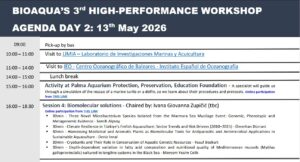
SECOND DAY OF THE WORKSHOP: Tuesday 13th May 2026
The second day features technical visits to leading marine research and aquaculture facilities in Mallorca, followed by an afternoon scientific session.
Morning Technical Visits
Visit to LIMIA (Laboratorio de Investigaciones Marinas y Acuicultura): Participants will enjoy a deck-based tour of research facilities focusing on marine finfish and shellfish aquaculture. Researchers from the Biology Department of Universitat de les Illes Balears will describe collaborative research projects on Mediterranean species adaptation to climate change.
Visit to IEO (Centro Oceanográfico de Baleares – Instituto Español de Oceanografía): The group will split into two for guided tours of this reference center for Mediterranean oceanography and marine resource assessment. Participants will observe ongoing research on climate impacts on marine ecosystems and sustainable fisheries management approaches.
Afternoon Activity and Session
Palma Aquarium Protection, Preservation, Education Foundation Activity: A specialist will guide participants through a simulation of marine turtle and dolphin rescue protocols, providing insights into marine wildlife conservation challenges in the Mediterranean and rehabilitation procedures for stranded or injured animals.
Session 4: Biomolecular Solutions
Chaired by Ivana Giovanna Zupičić, this extended session features five 30-minute presentations addressing climate resilience through biomolecular and genetic approaches.
Semih Alpsoy is presenting “Three Novel Microbacterium Species Isolated from the Marmara Sea Mucilage Event: Genomic, Phenotypic and Metagenomic Evidence,” analyzing microbial communities associated with the unprecedented 2021 mucilage event and their potential roles in ecosystem health.
Ömerhan Dürrani discusses “Climate Resilience in Türkiye’s Finfish Aquaculture: Sector Trends and Risk Drivers (2010–2025),” providing comprehensive analysis of how Turkish aquaculture has responded to climate variability and identifying vulnerability factors.
Dr. Deniz İnnal presents “Harnessing Medicinal and Aromatic Plants as Biomolecular Tools for Antiparasitic and Antimicrobial Applications in Sustainable Aquaculture,” exploring natural product alternatives to synthetic therapeutics.
Dr. Yusuf Bozkurt discusses “Cryobanks and Their Role in Conservation of Aquatic Genetic Resources,” emphasizing the importance of genetic resource preservation for climate adaptation and breeding programs.
Dr. Meryem Yesim Celik concludes with “Depth-Dependent Variation in Fatty Acid Composition and Nutritional Quality of Mediterranean Mussels (Mytilus galloprovincialis) Cultured in Longline Systems in the Black Sea,” examining how environmental conditions affect product quality in bivalve aquaculture.
Key Themes and Outcomes
The 3rd High-Performance Workshop integrates climate resilience perspectives across technical, welfare, and sustainability dimensions of European aquaculture. Key themes emerge around:
- Climate Adaptation Technologies: Sensor networks, early warning systems, and data-driven decision support tools essential for managing climate variability
- Antimicrobial Alternatives: Natural products, probiotics, and quorum-sensing modulators reducing antibiotic dependence
- Genetic Resource Management: Cryopreservation and selective breeding for climate-resilient stocks
- Sustainability Planning: Post-Action frameworks ensuring BioAqua deliverables achieve lasting impact through stakeholder engagement
The Mallorca workshop location provides unique opportunities to observe Mediterranean aquaculture systems directly affected by climate pressures, from warming waters to altered disease patterns, reinforcing the urgency of implementing biomolecular solutions at commercial scale.
Looking Ahead
The success of BioAqua’s 3rd High-Performance Workshop positions the Action for effective sustainability implementation as the 2027 conclusion approaches. The integration of climate resilience throughout technical presentations and strategic planning discussions ensures BioAqua deliverables remain relevant under future environmental conditions.
Building on frameworks established in Padova and be refined in Mallorca, the Action will move toward stakeholder engagement implementation, pilot program initiation, and funding pathway development that will secure lasting impact for European aquaculture innovation.